Community Contribution #2 – [Attempt #2]

Originally I made this post on Friday, as per the due date. That post is still alive, below. I’ve decided to leave it up for now. However, do ignore that if you are here to read my CC#2 (and thank you for being here). Please read this post instead:

This week I wanted to do things a bit differently. Rather than looking at the readings with the lens of a student; as assigned articles for discussing and arguing what they are discussing and arguing, I’m trying to look at this course instead as learning that can connect to my practice as an educator.

For one, I’m trying to move away from what the readings say about PLNs and instead work at hammering out a deeper understanding of what a PLN actually is for me and how it works in my professional life as a teacher. 

Especially now that I know for certain that I will be remaining in this course, I want to make it work for me. I’ve been looking at how I can take away practical learning from this course (for example, if I were to get my students to set up a blog). Additionally, I want to make this meaningful by looking at the PLNs I am already a part of, examining how they are currently contributing to my learning and growth as a teacher, and considering how I can maximize their potential to support my ongoing professional learning.

I met with my pod group on Friday and this is something we talked about as well. One group member is pursuing the path of optometry and the other is becoming a teacher. The three of us all seemed to have in common that we were still seeking a deeper understanding of how PLNs work in our fields, as opposed to our classmates who will use platforms like LinkedIn in the obvious ways. For example, as a teacher, I’ve never been active on LinkedIn. It has never seemed to apply to me, not for getting hired, and not for any meaningful networking related to my career.

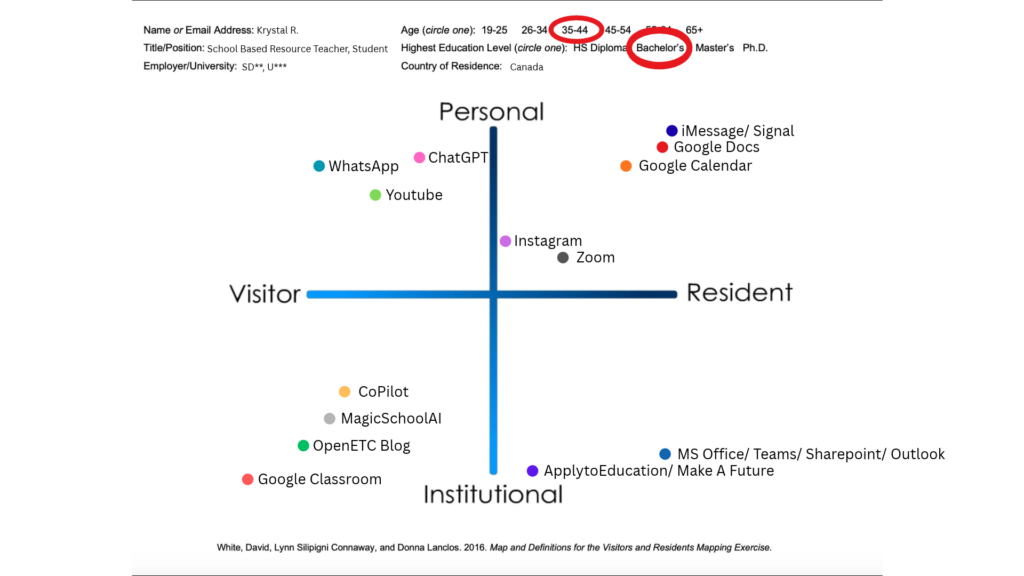
I started mapping out some of my professional network and connections I’ve built both in person and online. It made me think of connections I’ve built, or learning I’ve done, through professional development in the different school districts I’ve worked in. When I was in Yellowknife, one of the big consultants working with our district was Layton Schnellert. Many school districts have worked closely with him and Shelley Moore, particularly around meaningful inclusion. When I met Layton in Yellowknife, he talked about the work he had been doing in BC. He had worked with SD**. I had attended SD**. We talked about some of my former high school teachers he had worked with. And now I work in SD**, and I actually just found one of his books in the staff room that a former principal had left behind, and I picked it up!

I don’t use my full name online whenever I can help it. Aside from being listed as a teacher on my school website, I didn’t find anything about myself online, which is the intention. I have thought about it before, that my name (and location) is so public through my work which doesn’t feel completely comfortable to me.

I thought about the excerpt Adrian posted from Privilege of a Public Identity by Hilary Schmidt. Certain groups must be afforded reasonable accommodations. I wonder what kind of an answer I would get if I asked to remove my name from my employer’s website. And not just certain groups of people, perhaps we’re all owed some form of security. Like in Denmark?

This week I wanted to wait to meet with my Pod group until after I had a chance to do the readings. In hindsight I would’ve liked to meet earlier in the week. I found connecting with colleagues/ classmates provides valuable insight as we move through the assignments of the week.

Mapping ‘Visitors and Residents’ Exercise:
Community Contribution #2 – Analyzing Your Digital Identity

This week I wanted to do things a bit differently. Rather than looking at the readings with the lens of a student, as assigned articles for discussing and arguing what they are discussing and arguing, I’m trying to look at this course more as how it connects to my practice as an educator.

For one, I’m trying to move away from what the readings say about PLNs and instead work at hammering out a deeper understanding of what a PLN actually is for me and how it works in my professional life as a teacher.

I met with my pod group today and this is something we talked about as well. One group member is pursuing the path of optometry and the other is becoming a teacher (so the two of us had some things in common). The three of us all seemed to have in common that we were still seeking a deeper understanding of how PLNs work in our fields, as opposed to our classmates who will use platforms like LinkedIn in the obvious ways. For example, as a teacher, I’ve never been active on LinkedIn. It has never seemed to apply to me, not for getting hired, and not for any meaningful networking related to my career.

Especially now that I know for certain that I will be remaining in this course, I want to make it work for me. I’ve been looking at how I can take away practical learning from this course, for example, if I were to get my students to set up a blog. Additionally, I want to make it meaningful and look at the PLNs I’m already a part of and how I can make them work for me; and how they are currently contributing to my learning and growth as a teacher.

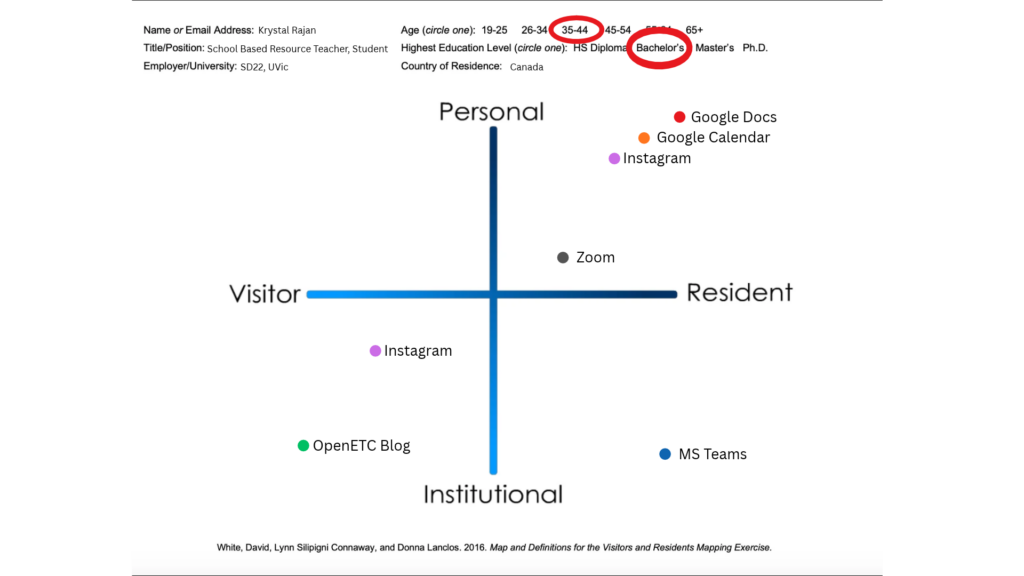
I started mapping out some of my professional network and connections I’ve built both in person and online. It made me think of connections I’ve built, or learning I’ve done, through professional development in the different school districts I’ve worked in. When I was in Yellowknife, one of the big consultants working with our district was Layton Schnellert. Many school districts have worked closely with him and Shelley Moore, particularly around meaningful inclusion. When I met Layton in Yellowknife, he talked about the work he had been doing in BC. He had worked with SD22. I had attended SD22. We talked about some of my former high school teachers he had worked with. And now I work in SD22, and I actually just found one of his books in the staff room that a leaving principal had left behind, and I picked it up!

I openly wrote “SD22” instead of “the district I work in” because when I search for myself online, my full name is listed on my school website, just as it is written here. I don’t use my full name online whenever I can help it. Aside from my school website, it was really hard to find anything about myself online, which is the intention. I have thought about it before, that my name is so public through my work which doesn’t feel completely comfortable to me.

I thought about the excerpt Adrian posted from Privilege of a Public Identity by Hilary Schmidt. Certain groups must be afforded reasonable accommodations. I wonder what kind of an answer I would get if I asked to remove my name from my employer’s website.

This week I wanted to wait to meet with my Pod group until after I had a chance to do the readings. In hindsight I would’ve liked to meet earlier in the week. I found connecting with colleagues/ classmates provides valuable insight as we move through the assignments of the week.

Mapping ‘Visitors and Residents’ Exercise:
Blog Post #1 – Privacy, Identity, and Learning in Digital Spaces

Coming into this course, concerns about privacy in online spaces were already on my mind, which is why I found the concept of networked privacy particularly interesting. The reading resonated with my existing understanding that privacy is not simply the result of individual choices or responsibility. Even when we are intentional about what we share, our online presence is shaped by the actions of others, the platforms we use, and the networks we participate in. What I appreciated about the reading was how it provided a framework for understanding privacy as a social and collective process rather than a purely individual one.

As I reflected on the reading, I found myself thinking about the tension between participation and privacy. Professional learning networks encourage educators and students to connect, share ideas, and engage publicly with others, but participation in these spaces also means accepting that information can move beyond its original context or audience. This aligns with some of the reservations I have about maintaining a strong online presence. While I value opportunities for connection and learning, I think it is reasonable to be cautious about visibility and the permanence of information shared online.

At the same time, this week’s materials highlighted why many students choose to participate in digital spaces to build professional networks. These are platforms such as LinkedIn, blogs, podcasts, discipline-specific online communities that allow people to connect with experts and access current information, and even Instagram and Youtube. These allow students to engage in conversations and access ideas that extend beyond the classroom. Personal Learning Networks create opportunities for learning that are more immediate, collaborative, and interest-driven than traditional professional development.

One valuable aspect of PLNs is the opportunity to encounter diverse perspectives and challenge existing thinking. Spracklen explains how online communities allow people to develop social networks around shared interests and engage with communities beyond their immediate geographic and social environments. This has the potential to expose us to ideas and experiences that challenge our assumptions and broaden our understanding. 

An author I follow on social media said something one time that drastically changed my experience. They reminded their audience of the idea that we are all more alike than we are different, and how those people that you could never imagine agreeing with on their wildly “problematic” (to us) ideas, they merely are being fed different propaganda to what we are being fed- but that we are all being fed propaganda. This has helped me continue to see people as human; people who I would have thought deny me my humanity by posting political ideas that are truly hurtful to myself and to many groups of people. It has saved me to remember them as more like me than unlike me. As indeed it is true that the facism machine works intentionally to divide us… but that might be a different topic.

Overall, this week’s readings reinforced for me that participating in digital spaces requires thoughtful intention, and a balance between connection and privacy.

Flight Path

Current Coordinates

As a teacher, and particularly in my current role, my work is entirely centred around individual students, how they learn, what gets in the way of their learning, what helps them feel safe and successful, and how we can make school more accessible and meaningful for them. I have lived and taught in a number of different places. Those experiences have shaped how I think about education and learning. I bring my experience with teaching, pedagogy, relationship-building, and adapting learning to different people and contexts. I also bring a strong interest in art and storytelling. What I don’t bring is a deep technical background in creating multimedia or using social media intentionally as a learning tool. 

Mapping the Route

I am interested in exploring what happens when some of the things I already value about education (personalization, creativity, connection, accessibility, and student agency) are brought into digital spaces. I am particularly interested in personalized learning and how technology can support learners who don’t necessarily fit neatly into traditional educational structures. I would also like to develop a better understanding of social media as something more than entertainment or communication. I am interested in how educators build personal learning networks and learn from people outside their immediate school or professional communities. I think there is a lot of potential there, but also a lot that needs to be questioned. The idea that the internet is not a neutral or equal space is especially interesting to me because questions of access, power, representation, and whose knowledge is valued are already things I think about in education.

I am also curious about GenAI and how it can be used appropriately in creative and educational work. I want to think about when these tools actually support learning and creativity, and what educators need to understand about privacy, ownership, copyright, bias, and authorship when using them.

Anticipating Turbulence

The most daunting part for me will probably be the technical and unfamiliar side of the course, as well as, of course, ensuring I’m able to carve out the time required to appropriately dedicate myself to this course.

I also have some hesitation about putting myself on the internet. I have had to navigate safety concerns in the past, so feeling exposed online does not feel comfortable to me. I am interested in participating in digital and networked spaces, but I also want to learn how to do that while maintaining reasonable boundaries around my privacy and personal identity.

My goal for this course is ultimately to leave with more than a collection of digital skills. I want to become more thoughtful and capable in the ways I learn, create, connect, and participate online, and to understand how those things can contribute to the kind of educator I want to be.